
Climbing Equipment Startup
June 2020 - Present

Introduction
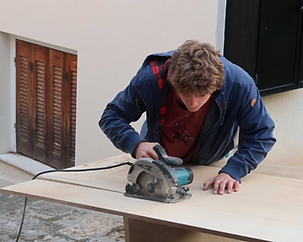
After building 2 climbing walls and many holds, I decided to use the skills I developed from this to make and sell climbing training equipment locally.
I was accepting custom orders, which meant that due to my limited experience at the start, almost every customer was requesting something which I had never made before. This was a great challenge, and it meant I spent many hours experimenting and evaluating new techniques and prototypes.
Instagram: @jclimbingfactory
Fingerboards

Wooden Holds

Dual-Texture


Fingerboards
Brief
To create custom fingerboards responding to the customer's requests and needs.
Previously to selling, I had minimal experience making fingerboards, meaning that I had to thoroughly test, and make adjustments to each design to ensure a positive user experience each time.
Design
Each fingerboard was designed to fulfil the customer's requirements. For example, a customer may request one fingerboard may need 3 edges ranging from 30-10mm, a set of pinches, and a jug, within a set of specific dimensions. It was then my role to create this design, before coming back to the customer to confirm the order.
When a challenging design was met, I would take the time to evaluate and attempt creating a prototype before confirming the project with the customer. This meant that each customer had a realistic expectation of what to expect.
Manufacturing
Although I previously had minimal experience in making fingerboards, the skills learnt through manufacturing holds and walls were directly transferrable, making for a smooth transition process.
Unlike the majority of climbing equipment manufacturers, I had no access to digital making equipment such as CNC machinery, which meant that all the designs were made by hand, with the need for high attention to detail.
This can be a disadvantage as it decreases the speed of manufacturing as well as reduces precision. Although ultimately, at the rate that I was required to work at the time, this was highly beneficial as it further contributed in my learning of essential woodworking skills, as well as keeping a personal touch to each design


Wooden Holds
Brief
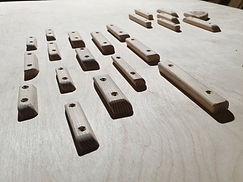
To create custom wooden holds responding to the customer's requests and needs.
Previously to selling, I had created over 400 holds to use on my own climbing walls which I had built. When doing so, I was able to 'go with the flow' on each hold. If an error was been made during the shaping, I would simply be able to change the shape entirely for my own use.
Although when completing a customer order, I learnt to replicate holds with higher accuracy to their requirements, increased efficiency and quality, while ensuring minimal errors were made.
Design
To give me an idea of the designs wanted, each customer would send me inspiration images of holds they would like me to replicate, with comments on desired adjustments. Open communication throughout the making process ensured their needs were satisfied while remaining within what my skill level was able to realistically produce.
Manufacturing
When manufacturing holds for my own wall, I was purely interested in how it felt to climb on, resulting in some holds which almost looked unfinished, and made out of softer wood.
Of course, when manufacturing for the market, I ensured that each of my designs looked more sleek, and were properly finished, which allowed me to develop a much more critical eye and attention to detail.
Similarly to the fingerboards, all holds are hand-made using basic woodworking machinery, mainly consisting of a bandsaw and a belt sander.




Dual-Texture
Brief
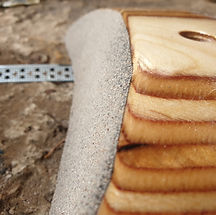
To make a set of dual-textured holds out of stacked plywood.
At the time, dual-textured holds were fairly new in the world of climbing, and a significant development. I decided to attempt creating my own set with no past experience in texturing climbing holds.
Design
The designs attempted to follow organic patterns, leading to sleek, modern climbing holds. This was my first attempt at shaping relatively large holds, which revealed the difficulty of the craft, and the start of a new journey.
This project took place before my knowledge in digital modelling and foam shaping and prototyping, meaning all the forms were created by feel, improvisation and trial and error.
Manufacturing
I used basic tools to create these shapes: A bandsaw to cut the rough shape of each plywood layer, followed by an angle grinder to create the final shape after the layers had been glued together.
The biggest challenge was the texture. I used marine varnish for the slick part, which turned out well. Although I had no knowledge in how to apply the gritted texture at the time. I attempted using polyurethane paint in combination with sand from the river. Yes... From the river. Surprisingly, it somewhat worked, but I was eager to learn how to do this professionally, leading to my internship in a climbing hold manufacturing company.