Key Memory
January - May 2023
Collaboration with Jonny Evans and Niclas Stengel
Brief
To create a design which solves an issue by linking two devices.
A common problem which we attempted to solve is people forgetting their keys in their homes. This is because unless you live with a flatmate who can let you in, this could lead to quite a costly outcome.
Research
After a number of interviews on campus, we were able to conclude that when looking at university students, a significant proportion would benefit from our proposed design. 70% of participants had forgotten their keys at least in the last 3 months, 20% of whom had to pay services to be let in. We found that 36% of participants usually place their keys on a hook. This was the most popular response, which we took forward in our design process.
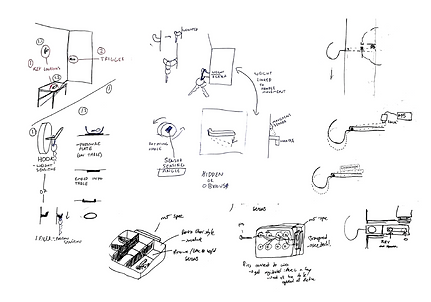
Brainstorming
We narrowed down our final design concept relatively quickly, as the problem we were aiming to solve was relatively straightforward in addition to being reinforced by our research.
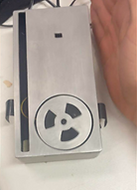
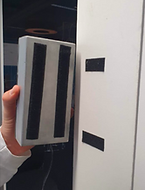
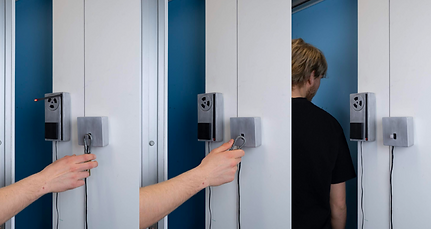
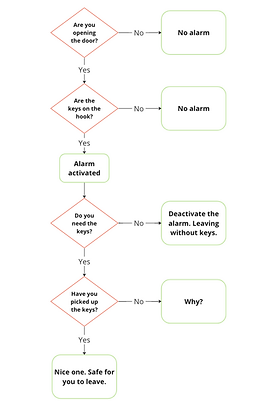
The design contains two components: a key hook, and an alarm. If the door is opened while the key is on the hook, the alarm activates three visual components: an ‘arm’, an LED, and a spinning disk. The alarm can be deactivated with the push of a button, or by retrieving the key.
After some sketches of how the mechanics of our idea could work, we went into testing these concepts, progressing through many iterations and trial and error.
The desired design aesthetic is inspired by Dieter Rams.


Manufacturing
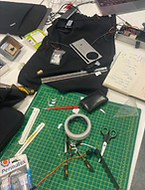
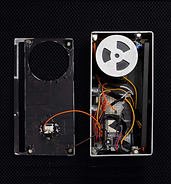
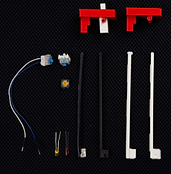
The bulk of our manufacturing process consisted of many separate prototypes, which were eventually connected as they developed. The electronics and code were first trialled on the low-resolution prototypes before progressing in the more resolved designs.
Our team worked well to use each of our strengths effectively, making quick progress through each prototype and development.
The casing is made of folded and welded plasma cut aluminium to create our desired retro aesthetic. The components which were required to be light-weight and precise to allow for wire channels were 3D printed, although these would be done using injection moulded in mass production.
The biggest challenge was working in a tight space, with the goal to fit 5 interactive electronic elements, while not having the affordance for any wiggle room in order to create a flush external finish. After some patience and the occasional bit of last-minute problem solving, we were able to create a final design we were all proud of.
Final Design
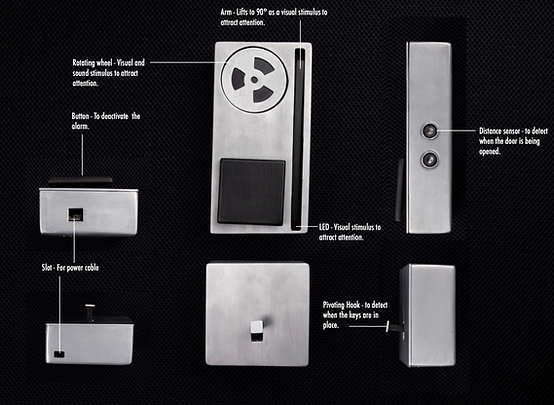
Coding Flowchart
Storyboard

1) The user opens the door with the key still on the hook, setting off the alarm.
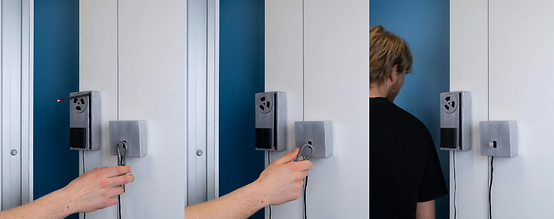
2) They take the key off the hook to leave, which turns off the alarm.
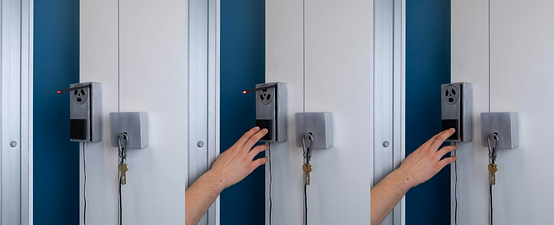
Alternative Scenario:
Opening the door to open for a guest, which sets off the alarm.
They can deactivate the alarm by pressing the button.