
Refurbishing Climbing Holds
May 2024 - Present
In collaboration with Holu Production


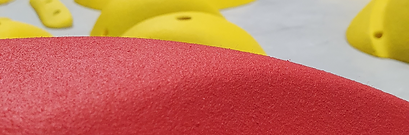
Brief
To refurbish climbing holds for climbing gyms in Greece, where this has not been done before.
Through working with 'Holu Productions' in Germany, I was able to source appropriate materials to refurbish holds to a professional standard.
Climbing holds are highly unsustainable, and my values as a designer aim to reduce waste from such toxic industries. Although there are ways which holds can begin to be more sustainable, and I would like to be a part of this change. Refurbishing holds is a good start.
Research
By working for 2 months with 'Holu Productions' I was able to learn how to efficiently refurbish climbing holds, what materials to use, and ensure that each project was being completed to a professional standard.
Although 'Holu' primarily makes climbing holds, a large number of holds were incoming for refurbishing, suggesting that this is an essential part of the industry which isn't present in my home in Greece.
Manufacturing
Firstly, each hold must be inspected to evaluate whether or not it is possible to refurbish. Any weak spots of the holds must be reinforced to ensure safety standards are met. If there is a doubt about its level of safety, I would recommend not to reintroduce it into the climbing gyms.
Next, the old texture is stripped, followed by any imperfections being cleaned up. This process is mostly 'decorative', meaning the wood itself must still be in a good enough condition to be structurally sound.
Finally, the new texture is applied using a combination of a special finishing material sand.
Final Product and Process Video